The sun was burning off the morning fog, residue from our several days of rain, as we set off northwest on I-270 on this car-powered field trip, stopping at nearly a dozen places in the Blue Ridge and Ridge and Valley provinces. We were again led by the local naturalist community’s answer to John Malkovich, the equally intense, hyper-organized Joe Marx.
 Our first stop was actually still in the Piedmont, in the parking lot of a Pier One Imports in Frederick, just down the U.S. 40 strip from the Barbara Frietchie restaurant. We looked at the Leesburg Member of the Balls Bluff Siltstone, a breccia composed of broken material from an alluvial fan under conditions similar (except for aridity) to those in the eastern edge of Death Valley. The boulders in the image were broken off from the bedrock and placed by construction activity.
 In class lectures, we’ve just been introduced to the various metamorphic rocks, so the timing of this field trip was apt. Moving farther west into Frederick County and into the Blue Ridge province, we explored the formations that make up the South Mountain Anticlinorium: a metagranite; the Catoctin Formation (composed of epidote-rich greenstone, a metabasalt); and the Weverton Formation, a sandstone metamorphosed to quartzite. We checked out the Weverton at Gambrill State Park from the grounds of an amenity known as the Tea Room. Nice views. Bluebirds, juncos, and lady beetles greeted us at the park. Moving on to Boonsboro, we stopped for the Loudoun Formation (phyllite) and the Harpers Formation (shales and phyllite).
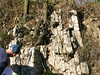 Continuing west, we entered the Ridge and Valley province. Our first stop was at the stone Wilson Bridge, built in 1819 by Silas Harry (and rehabbed in 1984 by LeRoy E. Myers) to carry the National Road across Conococheague Creek. Bedrock here is limestone and shale, and the creek follows the shale (lest it dissolve its bed of limestone). On the west side, up a short hill, are outcrops of the Pinesburg Station Dolomite (ca. 472 Ma) and the Chambersburg Limestone (just younger, 472-461 Ma). The dolomite, uptilted into almost vertical layers, laced with shale, is pictured.
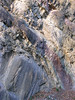
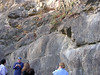 Pushing on the last of the season’s acid-yellow maples, we came to the Martinsburg Formation, a fissile (breaks in your hands) shale interbedded with graywacke. This turbidity-current deposit was first named by Swiss shepherds as flysch. And then continuing past Hancock, we came to the Western Maryland railroad cuts. The railroad ran parallel to the C&O Canal. When the cuts were made in the rock, ca. the beginning of the 20th century, the intricacies of folding captivated geologists and the lay public. Now the rocks are heavily weathered, but you can still see the lines of synclines and anticlines. At right, the line of white aligned with Joe’s head is an intrusion (perhaps from groundwater) of calcite.
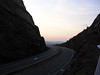 With the light fading, we wrapped up at the new poster child for geology, the giant road cut for I-68 through Sideling Hill. Even with the poor photographic conditions, the lines of the syncline (U-shaped) that form the top of the ridge are unmistakeable. Joe pointed out that it’s very rare for a ridgetop to be formed from an anticline (A-shaped), despite one’s intuition. Rocks stretched over the apex of an anticline break and quickly erode. Rather, what we observe is either a syncline (the rocks are compressed at the bottom of a fold and are somewhat more resistant to erosion) or a breached anticline (the apex is broken off), making two mirror-image ridges. Indeed, the whole of the South Mountain Anticlinorium is one such breached anticline, forming the Blue Ridge/South Mountain to the northwest and Catoctin Mountain to the southeast. The aha! of the trip was Anne’s, as she worked out just how immense the folded layers of rock would have to be to put the summit of Sideling Hill at the bottom of those folds. Our rocks here are the Rockwell Formation, and below that, the Purslane Formation.