 Some new friends, some old friends to reread.
Author: David Gorsline
-30-: 6
James Harbeck’s essay on memory and loss builds to a killer ending:
It’s because something is moving, and because something has moved and it’s not clear to you anymore. Or you have moved – it’s all the same result; all motion is relative. Emotion blur is common with family memories; all relatives are emotional.
Numbers game
WMATA’s survey about renumbering plans for Metrobus routes only runs thru 28 September, and it hasn’t been well publicized, so respond promptly. I have some concerns about the fixed order in which choices are presented. And there’s no space in the survey for general feedback. But I am warming to the idea of numbering routes according to hands of the clock.
My Mama and the Full-Scale Invasion
Sasha Denisova’s piece is an effective smash-up of memory play and topical satire, with a rotating set, live and canned video projections, and other theater tricks. With a recurring image of a huge mosquito with Vladimir Putin’s face surreally attached to it, there’s no question where Denisova and her titular Mama (always welcome Holly Twyford) stand on the current conflict.
Sasha’s Mama keeps herself grounded with traditional kitchen solutions to basic problems (no fridge? keep butter cool by submerging it in water), even as her appeals for relief in Kyiv climb the ladder of implausibility. A phone call with Ukrainian President Volodymyr Zelenskyy is followed up by interviews with increasingly powerful leaders, both global and extra-global. The projections enable what might be the first and only artistically defensible deepfake videos, as supporting cast member Linsday Smiling impersonates Emmanuel Macron and Olaf Scholz in turn.
Director Yury Urnov employs other theatrical devices, including a slithering, bloodsucking Putin (Suli Holum in a full-head Putin mask) that brings to mind the depersonalized work of Jean-Claude van Ittalie. Holum, as narrator, Daughter, and stand-in for the playwright, keeps the audience engaged with a warm, charismatic connection.
- My Mama and the Full-Scale Invasion, by Sasha Denisova, directed by Yury Urnov, Woolly Mammoth Theatre Company, Washington
It’s live theater: at Sunday evening’s performance, Twyford cut her hand while Mama was slicing onions and haranguing Zelenskyy on the phone. With professional aplomb, she called for a hold while bandages were quickly fetched.
Some links: 96
- New York begins to roll out new trash receptacles. A heavy base and a light basket that lifts out—what a concept.
- ChatGPT bails out on providing a precise quotation from Proust to Elif Batuman. Surprise, surprise.
2. Did ChatGPT seriously just recommend I “delve into Proust’s monumental work in its entirety”?
3. Am I being trolled?
4. Is it possible that the passage I’m thinking of wasn’t published until after September 2021?
5. No. - T. Rex explains why I like the original Rollerball (1975). (Well, Norman Jewison, James Caan, and John Houseman might have something to do with it.)
Power line grassland
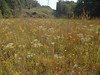 Nelson DeBarros led a walk for the Potowmack Grass Bunch and FCPA staff to a power line easement along South Run. This is a high-quality patch that probably benefited from a fire on 1 April. About an acre was burned.
I recorded one grass observation (to maintain my Grass Bunch apprenticeship), Nuttall’s Reedgrass (Greenechloa coarctica), but mostly I went after yellow forbs, as is my wont. Maryland Golden-Aster (Chrysopsis mariana) is new to me, and it’s always good to have someone help with an ID of Bearded Beggarticks (Tickseed Sunflower) (Bidens aristosa).
Purple False Foxglove (Agalinus purpurea) is hemiparasitic on graminoids and other hosts. Another illustration of my (not well-articulated) principle that every organism has a different way to make/buy/beg/borrow/steal a living from its environment.
Chuck it
Reminders from John D. Cook and Valerie Tiberius that my next planning session should focus on deciding not to do something. I already have an Evernote card titled “Books: I will never get around to reading, probably” (for example, Thomas Mann, Tolstoy, Terry Pratchett, and a few treatments of Joseph Cornell). And most of my personal Trello boards have a stack labelled “Deferred.”
It’s time to take this to the next level.
Some ink: 16
Once again, the Clifton Institute’s photographer has caught me in an awkward pose, this time holding the radio receiver during a workshop on Eastern Box Turtles (Terrapene carolina carolina). But I’m workin’ my blue hat.
Some links: 95
- Peter Dreier for the Conversation: “five unsung labor movies, all based on real-life events, that, in my view, deserve more attention.”
- ChatGPT makes up stuff about John Kelly.
Perhaps the computer program trawled through the multiverse and found a timeline in which John Kelly had nabbed a Pulitzer for his “thoughtful musings on Twiggy, the water-skiing squirrel, and how weird it is that Sugar Pops are now called Corn Pops.”
- At Shorpy, a fine photo of a D.C. Transit streetcar (not a PCC this time).
- ICYMI: The U.S. Geological Survey is collecting dead lepidopterans found by community scientists in AL, GA, KS, NE, OK, and TX.
- An exploration of the oeuvre of Neil Breen (of Double Down and several others).
Sacramento 2023
Boots on the ground (well, sneakers) in Sacramento. I met the abundant Valley Oak (Quercus lobata), host to a wasp that induces huge apple-like galls; got reacquainted with Spotted Towhee (Pipilio maculatus); found new dragonflies, like Variegated Medowhawk (Sympetrum corruptum ); puzzled over yet another carrot family member, Bisnaga (Visnaga daucoides); and watched a small flock of songbirds that iNat and I are still sorting out.
 Here’s faithful Sancho the Chevy Bolt, my rental car, taking a break in the Yolo Bypass Wildlife Area, where I unsuccessfully sought a jinx bird who shall remain unnamed. eBird reported only a few individuals lingering in the week prior. All in all, August is rarely a good month for birding, wherever you are in the north, but this trip wasn’t just about birding.
The arboretum at the University of California, Davis was quite nice, and worth the quick trip. And the Crocker Art Museum, newly expanded since my last trip west, was a pleasant surprise. There’s some great ceramics there, and a decent collection of 20th and 21st century work. More Wayne Thiebaud than you usually get to see.

 I rode the light rail out to Folsom and had a dish of ice cream in memory of Mom.
Summary statistics and other data for the trip:
- Observations of Chris Ware in Oak Park: 0
- El car numbers: 5030, 2621, 5374, 5471, 5483, 5195 (twice), 5573, 5291, 5435, 5198, 5286
- Trainspotters spotted: 3
- Zephyr Salutes (none returned) along Moon River: I lost count
A passage in Jonathan Franzen’s recent “The Problem of Nature Writing” struck a note with me:
The very presence of a piece of writing leads us to expect an argument from it, if only an implicit argument for its existence. And, if the reader isn’t also offered an explicit argument, he or she may assign one to the piece, to fill the void. I confess to having had the curmudgeonly thought, while reading an account of someone’s visit to an exotic place like Borneo, that the conclusion to be drawn from it is that the writer has superior sensitivity to nature or superior luck in getting to go to such a place. This was surely not the intended argument. But avoiding the implication of “Admire me” or “Envy me” requires more attention to one’s tone of written voice than one might guess.
Whether it’s Borneo (never been) or the Blue Ridge, it’s true that I am fortunate to have the resources to travel across the commonwealth (and sometimes the country) and to bring back a bit of documentation. And I try to remember that I’m fortunate.
I keep this blog (a) to exercise my writing muscles, (b) to occasionally demonstrate to someone else that I can string sentences together, albeit with capricious use of punctuation and conjunctions, and (c) to leave a record for myself that I can come back to. OK, every once in a while (d) I get to write about something cool that I accomplished.
I’m too old to be the object of someone’s admiration. I guess that I need to keep that in mind.
California Zephyr 2023
A few snaps aboard Amtrak train 5, the California Zephyr, from Chicago to Sacramento via Denver and Salt Lake City.
 Climbing the mountains along South Boulder Creek, Gilpin County, Colorado.
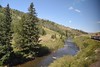 Having crossed the Continental Divide via the Moffat Tunnel, we’re now following the Fraser River downhill to its confluence with the Colorado.
 Uhh, somewhere on the Colorado River, still in the state of Colorado. (I failed to save my GPS fix.)
 And the next morning, having crossed Utah in the dark, here we are in Churchill County, Nevada, northeast of Reno.
Good food on both Amtrak trains (the Zephyr and the Capitol Limited). After three days you sort of get used to the bumpy ride. The Capitol Limited was 45 minutes late into Chicago (largely due to an automated systems failure at CSX); the Zephyr was two and a half hours late into Sacramento (late start due to two different cars that needed to be swapped out; amplified by an unplanned detour through the Union Pacific yards at Reno). Better than I expected!
Chicagoland architecture 2023
I assembled a three-legged trip for this year’s birthday excursion, stopping in Chicago to see my long-missed friend Janet in Chicago, and then on to Sacramento for a memorial service for Mom, hanging out with my cousin and her family, and exploring a few natural areas.
In Chicago, I stayed in the amenable Hotel Blake, one of the Loop hotels that has been repurposed from (usually historic) office buildings. My architecture focus was on older buildings—I love me some International Style and Brutalism, but Chicago’s earlier buildings are something extra special.
I took a lovely guided/audio tour of Frank Lloyd Wright’s home and studio in Oak Park and a sampling of his houses on Forest Avenue.
 Also a quick run up to Evanston to make sure all of the buildings I remember are still there (true, with one exception), taking a walk with Alice in the development office. The Weber Arch post-dates me, so this was my opportunity to make a procession of one through it.
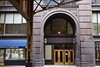 My target building in the Loop was the Monadnock Block. I fell in lurve with this structure when I saw photos of it for an art history course, but to the best of my recollection, this is the first time that I’ve seen it in the stone. It’s just inside the El’s Loop, as you can see from the structures in the foreground.
 Street level businesses are hanging on, including a sandwich shop and a rather smart bistro.

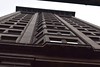 Gotta snap the fire escapes. And, oh, those delicious Chicago bay windows.

 Noted in my AIA guide was the Reliance Building, now a Staypineapple hotel.
 According to Janet, some people back in the day found the nearly floor-to-ceiling windows a bit vertiginous.
 Some street furniture: engraved street name signs for Michigan Avenue at Van Buren Street,

 and a cheeky Art Nouveau station entrance marker for Metra.
 The Hotel Blake is south of Ida B. Wells Drive, in the semi-revived neighborhood of Printers’ Row.

 The end of Dearborn Street is anchored by the old Dearborn Station. No more trains, and not much else happening in this building, alas.
 We looked through my Flickr feed during Japanese class (“what did you do on vacation?” prompts). My classmate Kathy remarked, “There are no pictures of people.” So here’s a picture of me, just for Kathy.
 I enjoyed a little time in Millennium Park, but I gravitated to old school Grant Park (to honor those who marched) and Buckingham Fountain. Nice shiny-shiny towers in the background.
Clifton Institute bioblitz August 2023
 Almost perfect weather yesterday for traipsing and documenting. We surveyed a farm up on the Piedmont of western Fauquier County that is being converted from cattle pasture to a more native plant-based flora.

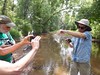
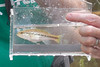 The farm backs on to an upper reach of the Rappahannock River, this summer not running with much water due to our moderate drought. But Bert Harris and helpers managed to net a Largemouth Bass (Micropterus salmoides) for observation and release.
After I chased an Eastern Wood-Pewee (Contopus virens) for half an hour, it settled down to sally from a perch, giving me some excellent, well-lighted looks. I’m not fond of Box Elder (Acer negundo) as a rule, but some of the trees in the river bottom are delightfully gnarly and chonky.
It’s a bioblitz, so everything counts, including Pokeweed (Phytolacca americana) and Bottlebrush Grass (Elymus hystrix) and Eastern Gray Squirrel (Sciurus carolinensis). This one caught our attention because it was loudly gnawing on a bone.
After sifting out the out-of-focus shots and doing my best to color-correct the greenish cast given off by the mercury vapor lamp, I was able to contribute 49 observations to the project.
At the end of the day, as we started to drift back towards the cars, someone gave up a shout, because a female Eastern Hercules Beetle (Dynastes tityus) had come to the light.
09:32

 Documenting and celebrating Dark Star Park Day in Rosslyn.
Parting words from Clint Maroon
“I could show you this country’s gone a long ways in the last fifty sixty years. I don’t mean machinery and education and that. I mean folks’ rights. They’ve clamped down on fellows like me who damn near ruined this country….
“Another quarter century of grabbers like us and there wouldn’t have been a decent stretch of forest or soil or waterway that hadn’t been divided among us. Museums and paintings and libraries—that’s was our way of trying to make peace with our conscience. I’m the last of the crowd that had all four feet in the trough and nothing to stop ’em. We’re getting along toward a real democracy now and don’t let anybody tell you different. These will be known as the good new days and those were the bad old days. The time’s coming when there’ll be no such thing as a multi-millionaire in America, and no such thing as a pauper. You’ll live to see it but I won’t. That’ll be a real democracy.”
—Edna Ferber, Saratoga Trunk (1941) (pp. 350-351)